

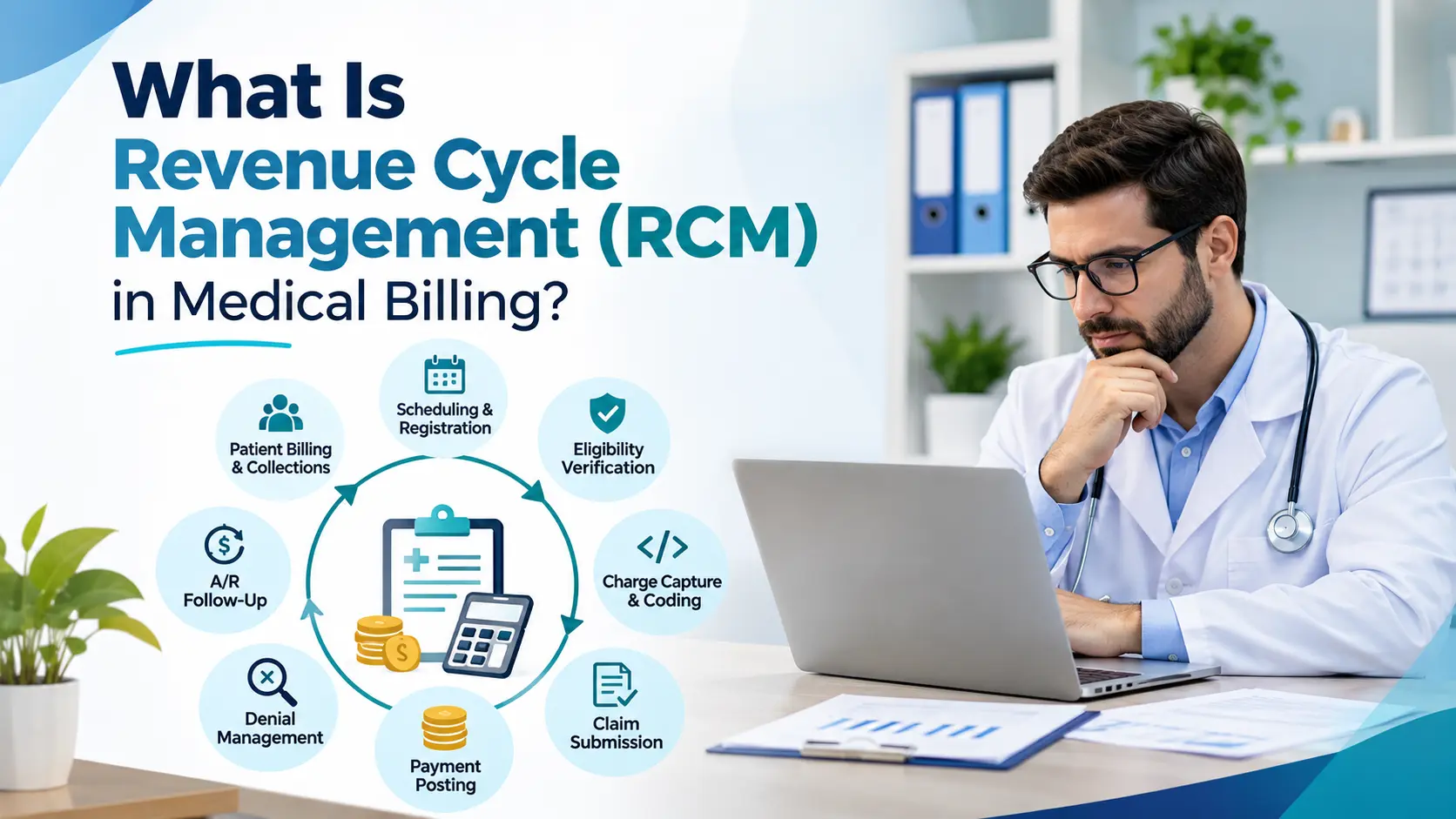
What Is Revenue Cycle Management (RCM) in Healthcare?
Revenue cycle management, usually shortened to RCM, is the financial workflow attached to every patient visit. Industry groups such as the Healthcare Financial Management Association describe it as the administrative and clinical functions that capture, manage, and collect patient service revenue.
Picture a relay race. The front desk starts it, clinicians document the visit, coders turn that note into billing codes, billers send the claim, and payers respond. If one runner drops the baton, the claim slows down or stops. RCM is the system that keeps every handoff clean.
That matters more than most owners expect. A practice can deliver excellent care and still struggle if claims are late, denied, or never followed up. Care brings patients in. The revenue cycle keeps the doors open.
RCM vs Medical Billing: What Is the Difference?
People often use the two terms as if they mean the same thing. They do not. Medical billing is one stage inside RCM, while RCM follows the patient account from start to finish.
| Area | Medical Billing | Revenue Cycle Management |
|---|---|---|
| Scope | Claim creation, submission, and follow-up | Scheduling through final payment |
| Starting point | After the visit | Before the visit |
| Eligibility checks | Rarely included | Included |
| Coding review | Sometimes | Included |
| Denial management | Sometimes | Included |
| Reporting | Basic | KPI tracking and trend analysis |
In other words, billing is a task. RCM is the whole financial process around that task.
The Revenue Cycle Management Process: Step by Step
Most practices follow eight stages. Each one has its own way of losing money, so it pays to know what to watch at every step.
1. Patient Scheduling and Pre-Registration
The cycle starts when someone books a visit. Staff collect demographics, insurance details, and the reason for the appointment. A wrong birth date or an old policy number here can trigger a denial weeks later. Getting this data right takes minutes. Fixing it later costs far more.
2. Insurance Eligibility Verification
Before the visit, the team confirms that coverage is active and checks benefits, copays, and authorization rules. Skipping this step is one of the most common reasons claims bounce. Catching a lapsed policy at the front desk is much easier than chasing a patient after the fact.
3. Charge Capture and Medical Coding
After the visit, the provider’s notes are turned into diagnosis and procedure codes. Accurate medical coding matters because the code tells the payer what happened and what to pay. Under-coding leaves money behind, and over-coding invites audits. Certified coders keep documentation and codes aligned.
4. Claim Submission
Coded charges become a claim and go to the payer, usually through a clearinghouse. Good teams scrub claims first, which means checking for missing fields and code conflicts before anything leaves the building. A clean claim gets paid faster than one that needs rework.
5. Payment Posting
When payers send remittances, the payments are matched to the right claims and accounts. Payment posting also exposes underpayments, since the amount received can be compared against the expected rate. Sloppy posting hides problems until they pile up.
6. Denial Management and Appeals
Some claims come back denied or rejected. A strong denial management team does more than resubmit. It finds out why the denial happened, fixes the claim, appeals when appropriate, and feeds the cause back to the front end so the same error stops repeating.
7. Accounts Receivable Follow-Up
Unpaid claims age quickly. Regular accounts receivable (A/R) follow-up means working the oldest and highest-value balances first and contacting payers on a schedule. Without this routine, claims just sit in a queue while cash flow tightens.
8. Patient Billing and Collections
After insurance pays, the patient owes any remaining balance. Clear statements, simple payment options, and polite reminders keep this part moving. Patients who understand their bill tend to pay it.
Key RCM Metrics Every Practice Should Track
You cannot improve what you do not measure. The metrics below are the ones most billing teams watch, and the targets are commonly cited benchmarks from groups such as HFMA and MGMA. Treat them as reference points, since results vary by specialty and payer mix.
| Metric | What It Shows | Commonly Cited Target |
|---|---|---|
| Clean claim rate | Claims accepted on first submission | 95% or higher |
| Days in A/R | How long it takes to get paid | Under 40 days |
| Denial rate | Share of claims denied | Typically 5% to 10%, under 5% is ideal |
| Net collection rate | Share of the allowed amount actually collected | 95% to 99% |
Here is a quick example. If a practice sends 200 claims and 184 are accepted on the first try, its clean claim rate is 92%. That sits below the common 95% mark, which usually points to a front-end problem such as bad registration data or missing documentation.
Why RCM Matters and Where It Breaks Down
A healthy revenue cycle keeps cash flowing, so payroll, supplies, and rent get paid on time. It also cuts rework, supports compliance, and gives owners a clear picture of financial performance.
Problems tend to appear in the same places:
- Registration errors that trigger denials later
- Coding mistakes or missing documentation
- Payer rule changes that nobody tracked
- Slow follow-up on denied or unpaid claims
- No regular reporting, so issues stay invisible
Most of these start at the front end, not the back. That is why a good RCM partner looks at the whole cycle instead of only resubmitting rejected claims.
In-House vs Outsourced RCM
Some practices run RCM in-house with their own staff. That gives direct control, but it also means one resignation or sick week can stall the whole cycle.Other practices hire a medical billing partner for coverage, specialist knowledge, and regular reporting.The right choice depends on your claim volume, your team, and how much time billing takes away from patient care.If you are weighing the second route, our guide on whether to outsource medical billing covers the pros, cons, and contract points to check before you sign.
Why Choose Primemedbilling for Revenue Cycle Management?
Prime Med Billing brings more than 12 years of experience in revenue cycle management and medical billing services to solo physicians and groups across the United States.The team of 100+ professionals includes certified coders with credentials such as CPC and CIC.Claims go out with a 99.9% acceptance rate, accounts receivable gets daily follow-up, and real-time reporting shows how your billing is performing.
Moving from another biller? Prime Med Billing offers a comprehensive audit to clean up past discrepancies and aims to resolve revenue-impacting errors within 24 hours of that audit.If you want visibility into every step, read abouttransparent revenue cycle management.New providers can also add credentialing services to get enrolled with payers.To see how it would work for your practice, book a free consultation.
Frequently Asked Questions
What is revenue cycle management in simple words?
It is the process of managing a patient’s account from scheduling to final payment. It includes insurance checks, coding, billing, denial follow-up, and collections, so the practice gets paid correctly for the care it provides.
What are the main steps of the RCM process?
The steps are pre-registration, eligibility verification, charge capture and coding, claim submission, payment posting, denial management, A/R follow-up, and patient billing. Each step affects the one after it.
Is RCM the same as medical billing?
No. Billing is one step inside RCM. RCM also covers scheduling, eligibility checks, coding review, denial management, and performance reporting, so it spans the full patient-to-payment journey.
Why is revenue cycle management important?
It keeps cash flow steady, reduces claim rework, and shows where revenue is leaking. Without it, earned money can sit uncollected for months or never arrive at all.
Is outsourcing RCM a good fit for a small practice?
Often, yes, especially when billing falls on one or two busy people. A partner adds coverage and specialist knowledge. Compare scope, reporting, and contract terms before choosing one.
Conclusion
So, what is revenue cycle management at its core? It is the full path from the first phone call to the last payment, and every stage affects the next.Practices that verify coverage early, code accurately, work denials quickly, and track a few key metrics tend to get paid faster and with less stress.If your cycle feels slow or unpredictable, start by checking your clean claim rate and days in A/R, then decide whether in-house or outsourced support fits you best. Prime Med Billing is ready to review your cycle with you.